
What Is a Customer Feedback Loop?
A customer feedback loop is a system through which businesses collect, analyze, act on, and respond to customer feedback to continuously improve their products, services, and customer experience. A good customer feedback loop leverages modern platforms for automation.
Unlike one-time surveys, feedback loops create an ongoing cycle of improvement, turning customer insights into actions and actions into measurable business outcomes. A well-designed feedback loop ensures higher customer retention.
Why Customer Feedback Loops Matter More Than Ever
65% of U.S. customers find a positive experience with a brand to be more influential than great advertising. In an era where customer expectations are constantly evolving, businesses that build strong feedback loops stay ahead of the competition by delivering great experiences and being loved by customers.
Most businesses today are not short on customer feedback. They are short on systems to act on it. Surveys are sent. Responses are collected. Metrics and reports are reviewed. But very little changes at the ground level. Feedback remains buried in dashboards, discussed in silos across teams, or delayed until it is too late to act.
This is where customer feedback loops become critical. They ensure that issues are addressed on time and that every insight contributes to improvement in CX. Instead of being a passive metric, feedback becomes an active driver of growth.
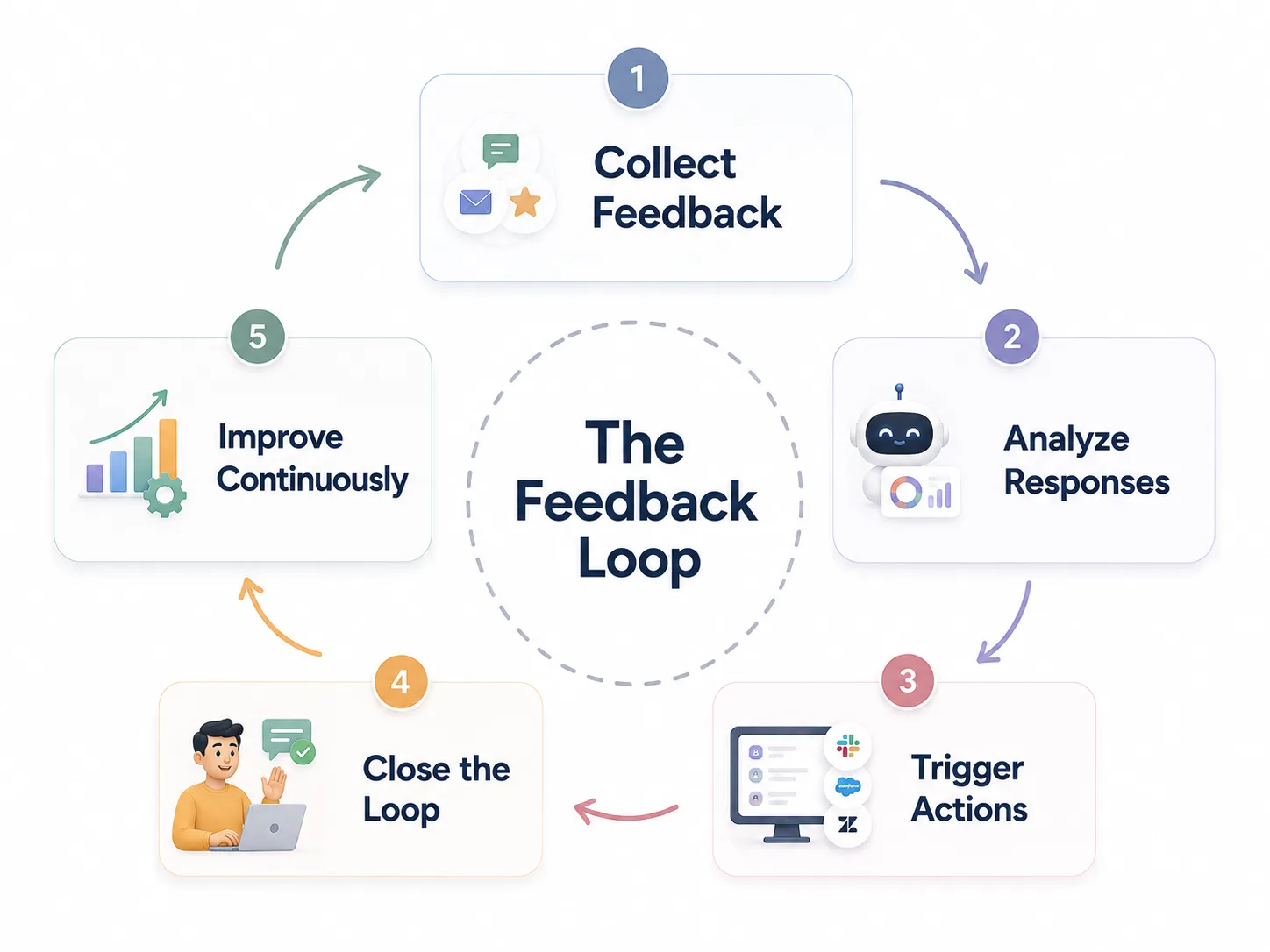
The Customer Feedback Loop Framework
At the heart of every effective feedback system is a simple but powerful framework. This framework works across customer experience or customer success teams, support teams, product teams, category or growth teams, and marketing teams.
Collect Feedback
Analyze Responses
Trigger Actions
Close the Loop
Improve Continuously
This framework is universal. Whether you're running a D2C eCommerce brand, a retail chain, a marketplace, or a SaaS business, the same loop applies.
How Feedback Loops Boost Business Growth
A customer feedback loop is the most critical initiative for a good customer experience, making it a strong lever for business growth.
Enhancing Customer Experience with Real Insights
In PwC's 2025 Customer Experience Survey, 29% of consumers said they stopped using or buying from a brand due to poor customer experience. This makes it critical for brands to run continuous feedback loops to identify gaps in customer experience and fix them.
Many businesses rely on assumptions when improving their products or services. Feedback loops replace assumptions with real customer insights. They help you identify patterns quickly — if multiple customers report the same issue, it becomes visible immediately. This allows teams to fix product defects faster, improve services, and optimize processes.
When customers tell you exactly what needs improvement and you act on it, you create delightful experiences.
Improving Retention Through Timely Intervention
One of the biggest benefits of feedback loops is the ability to identify dissatisfaction themes early. Instead of discovering churn after it happens, you can intervene while there is still time to retain the customer.
Businesses can set up systems to identify trend shifts early and automatically alert the relevant teams to intervene.
For example, an eCommerce brand that captures post-purchase feedback can identify an emerging trend of poor delivery experiences. With a well-designed feedback loop, they can resolve it before it impacts a large customer base and affects repeat purchases.
Building Trust Through Responsiveness
Customers may forgive your imperfections as long as you are responsive. When you acknowledge feedback, act on it, and follow up, you build trust. Over time, this trust translates into loyalty and positive word-of-mouth.
For example, setting up a workflow to automatically create a support ticket for a detractor would lead to prompt redemption — a support agent could call the customer to apologize for the poor experience, making the customer feel heard.
Turning Satisfaction into Growth
Promoters, or your happiest customers, are often underutilized. By using the right tools to create an effective feedback loop, you can automatically request social reviews and referrals from customers who are loyal to you. This turns satisfied customers into your ambassadors.
Need Help Creating an Effective Customer Feedback Loop?
Affiniv automates the full loop — from survey triggers to AI insights to automated follow-ups.
Types of Customer Feedback Loops
Not all feedback loops serve the same purpose. The most effective systems combine multiple types to cover different stages of the customer journey.
NPS Feedback Loop
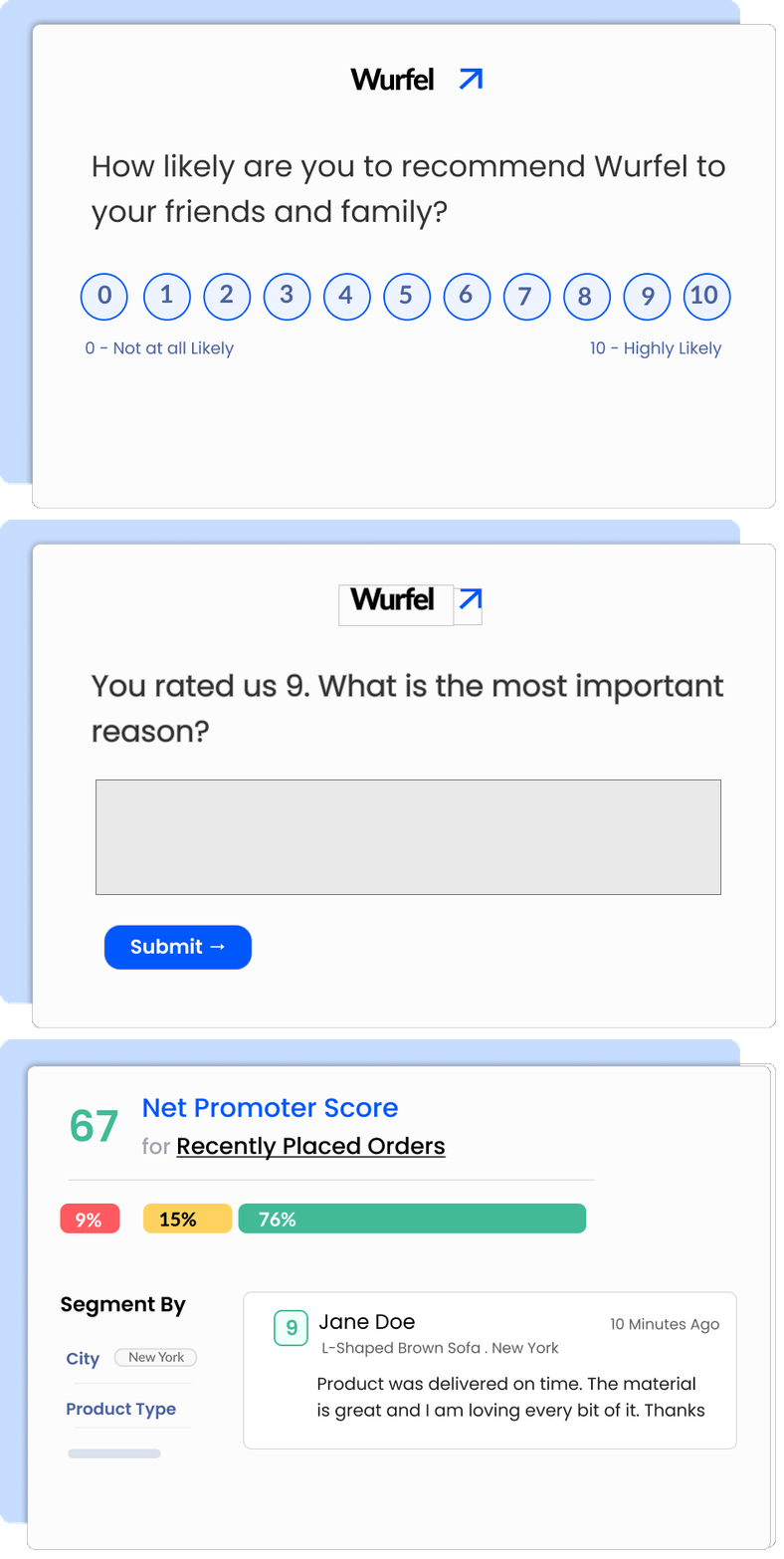
The Net Promoter Score feedback loop gauges long-term customer loyalty.
Relational NPS is typically measured quarterly and is best used to understand overall brand perception and identify churn risks. Transactional NPS (tNPS) is used to measure customer loyalty after a specific interaction.
It is measured on an 11-point scale from 0 to 10.
CSAT Feedback Loop
Customer Satisfaction, or CSAT, focuses on specific interactions and is an alternative to tNPS. It is typically used after support interactions, deliveries, or service experiences.
CSAT helps you understand how satisfied customers are with a particular moment. It is typically measured on a 5-point numeric or visual scale, such as a star rating.
CES Feedback Loop
Customer Effort Score, or CES, measures how easy it is for customers to interact with a business, such as seeking support or completing a task.
It is especially useful in identifying customer friction points in self-service tasks, onboarding flows, checkout experiences, and support resolution. It can be measured on a 5-point or 7-point numeric scale.
| Feedback Loop | What It Measures | Best Used For |
|---|---|---|
| NPS | Customer loyalty and likelihood to recommend | Overall brand perception, retention risk, review and referral activation |
| CSAT | Satisfaction with a specific interaction or experience | Support interaction, delivery experience, service experience |
| CES | How easy or difficult it was to complete a task | Self-serve flows, checkout, onboarding, support resolution |
Together, NPS, CSAT, and CES create a complete feedback system that covers loyalty, satisfaction, and effort.
How to Build a Customer Feedback Loop
Building a feedback loop is not just about sending surveys. It is about designing a comprehensive system to keep your business responsive to customer needs.
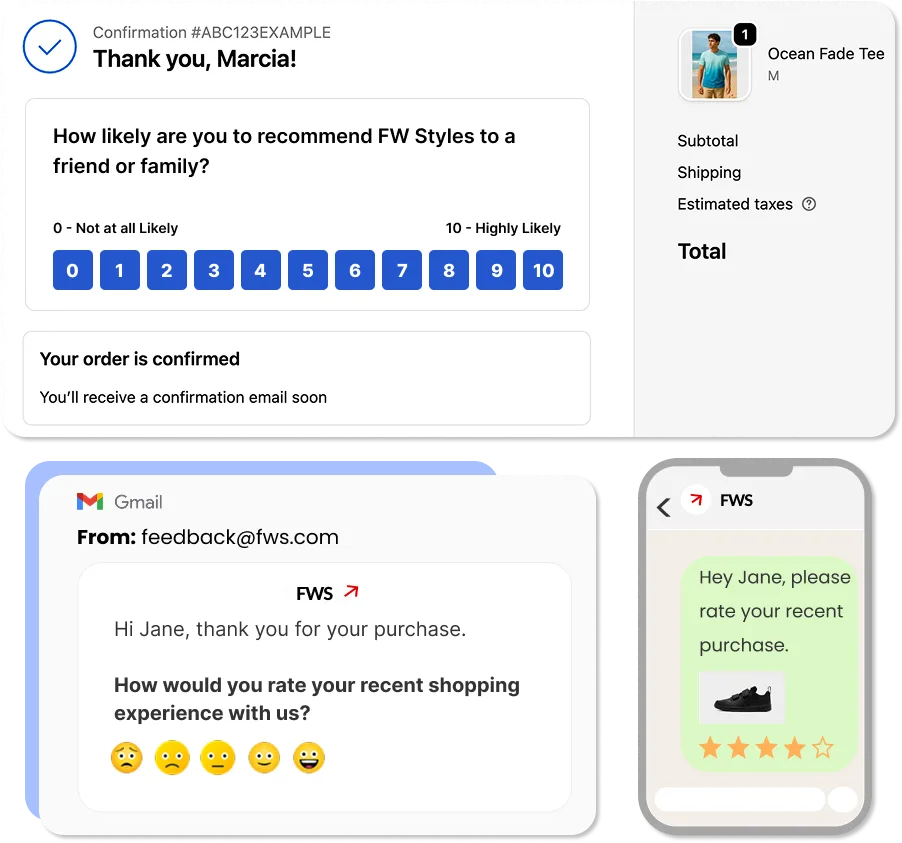
Step 1: Collect Feedback at the Right Moments Using the Right Channels
The effectiveness of feedback surveys depends heavily on the volume and accuracy of the responses. Customers are more likely to provide meaningful insights when you reach them through a channel that is accessible to them and when their experience is fresh.
For example, checkout flow feedback collected on the Thank You page is likely to be more accurate than the same feedback collected weeks later via email or WhatsApp.
However, over-surveying can lead to fatigue. So you need to be smart about the touchpoints where you want to survey your customers. Use a customer feedback platform, such as Affiniv, to automate omnichannel survey triggers based on customer actions.
Important: Make Feedback Accessible to All Departments
Collecting customer feedback is only the first step; integrating it into your business strategy is where the real value lies. The first step in this integration is to ensure that feedback is accessible to all relevant departments. Whether it's customer success, category, operations, product development, marketing, or customer service, every department should have access to the insights gathered. This collaborative approach ensures that feedback is acted upon in a coordinated and effective manner.
Step 2: Analyze the Feedback for Actionable Insights
Next, develop a systematic process for analyzing and acting on the feedback. This could involve regular meetings to discuss feedback trends and identify action items.
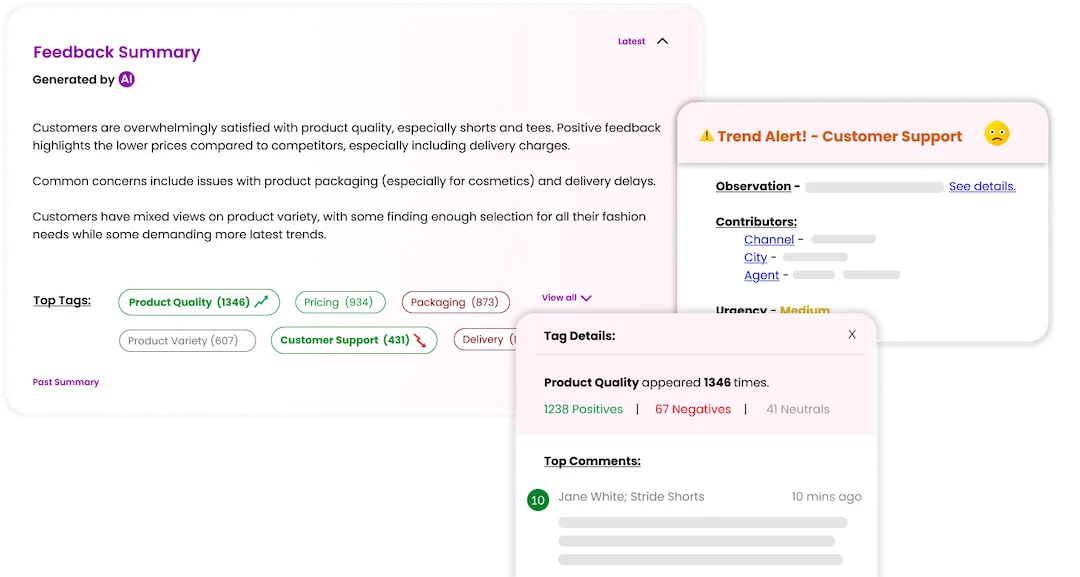
Categorize feedback into themes like product quality, customer service, or pricing to identify common issues and trends. Delve deeper into each theme to identify specific pain points and areas for improvement. Look for patterns and recurring issues that need immediate attention.
Modern customer feedback platforms, such as Affiniv, provide AI-powered text response summaries, automated categorization of feedback, and trend analysis, highlighting areas with significant changes in customer sentiment. This allows you to prioritize actions effectively without spending a lot of time on analysis.
Step 3: Act on the Insights
Translate these insights into concrete action plans. Develop strategies to ensure that your team's effort is focused where it matters most.
For example, segmenting issues based on impact will help you prioritize actions. Based on the priorities, assign responsibilities and set measurable goals with timelines. Regularly review the impact of changes and adjust strategies as needed.
This data-driven approach ensures your business remains agile and constantly improves your customer experience.
Turn Customer Feedback Into Action
Affiniv helps teams automate surveys, workflows, alerts, and follow-ups across the customer journey.
Step 4: Close the Loop with Customers
Closing the loop is what transforms feedback into trust. It happens at two stages: first, acknowledging the feedback as early as possible, and second, communicating back to the customer after taking corrective action.
For instance, if a customer reports a delivery delay, simply fixing the issue is not enough. First, you must immediately acknowledge the lapse and apologize. Later, you must inform them that their feedback led to a process improvement. This is what creates a stronger connection.
Loop closures are not meant for unhappy customers alone. An example of closing the loop with happy customers is expressing gratitude and requesting a social review or referral.
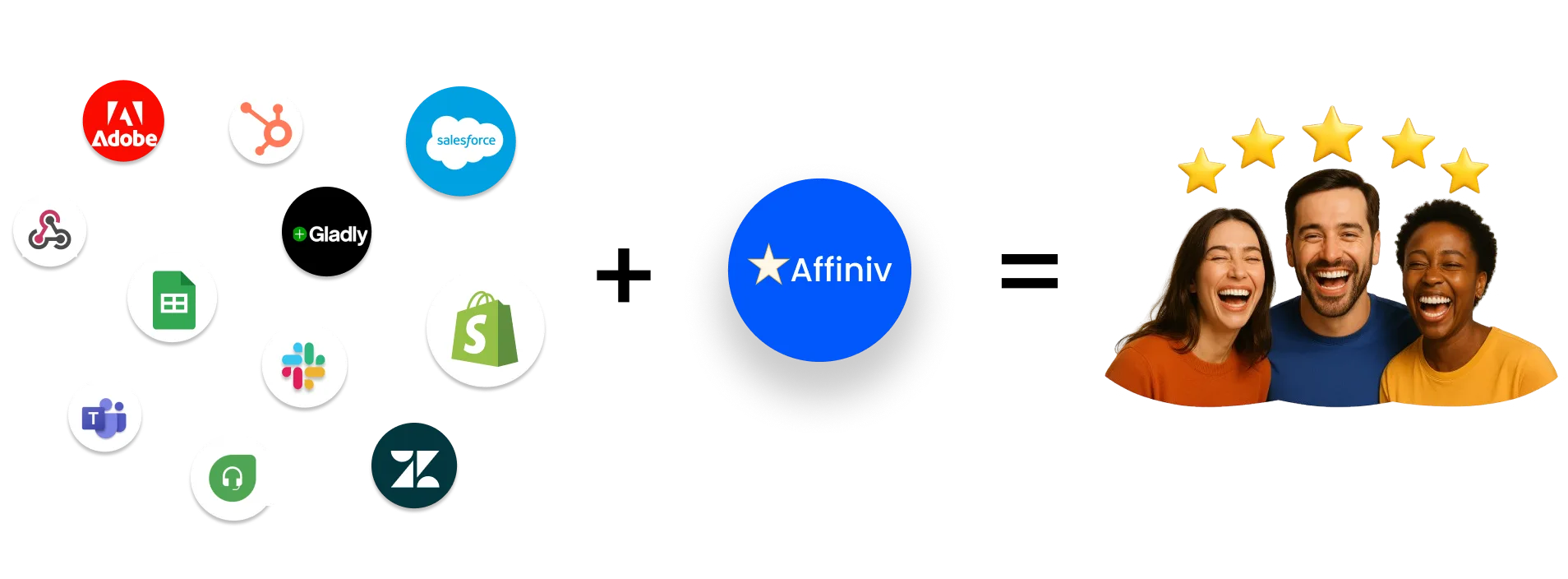
Automated workflows, such as a support ticket with details for a dissatisfied customer, or alerts on a Slack channel, ensure that the first contact happens instantly and consistently. Affiniv integrates with helpdesk software like Zendesk, Freshdesk, Gorgias, and more to enable this. With Affiniv, you can also send automated review requests to your satisfied customers.
Step 5: Track, Learn, and Improve
Feedback loops are continuous. The goal is not just to respond and close, but to learn and improve. By analyzing feedback trends, you can identify recurring issues, improve product features, and optimize processes.
By combining customer feedback with metrics like NPS, CSAT, and CES, you can track the impact of your actions on customer sentiment over time.
Create a Feedback Survey in 5 Minutes
Get NPS, CSAT, and CES templates on Affiniv.
Customer Feedback Loop Case Studies
Here are some real-world examples of effective customer feedback loops.
Funko: E-Commerce & Retail Post-Purchase Surveys
Funko Inc., a leading company in pop culture lifestyle and consumer products, relies heavily on customer feedback to improve its services.
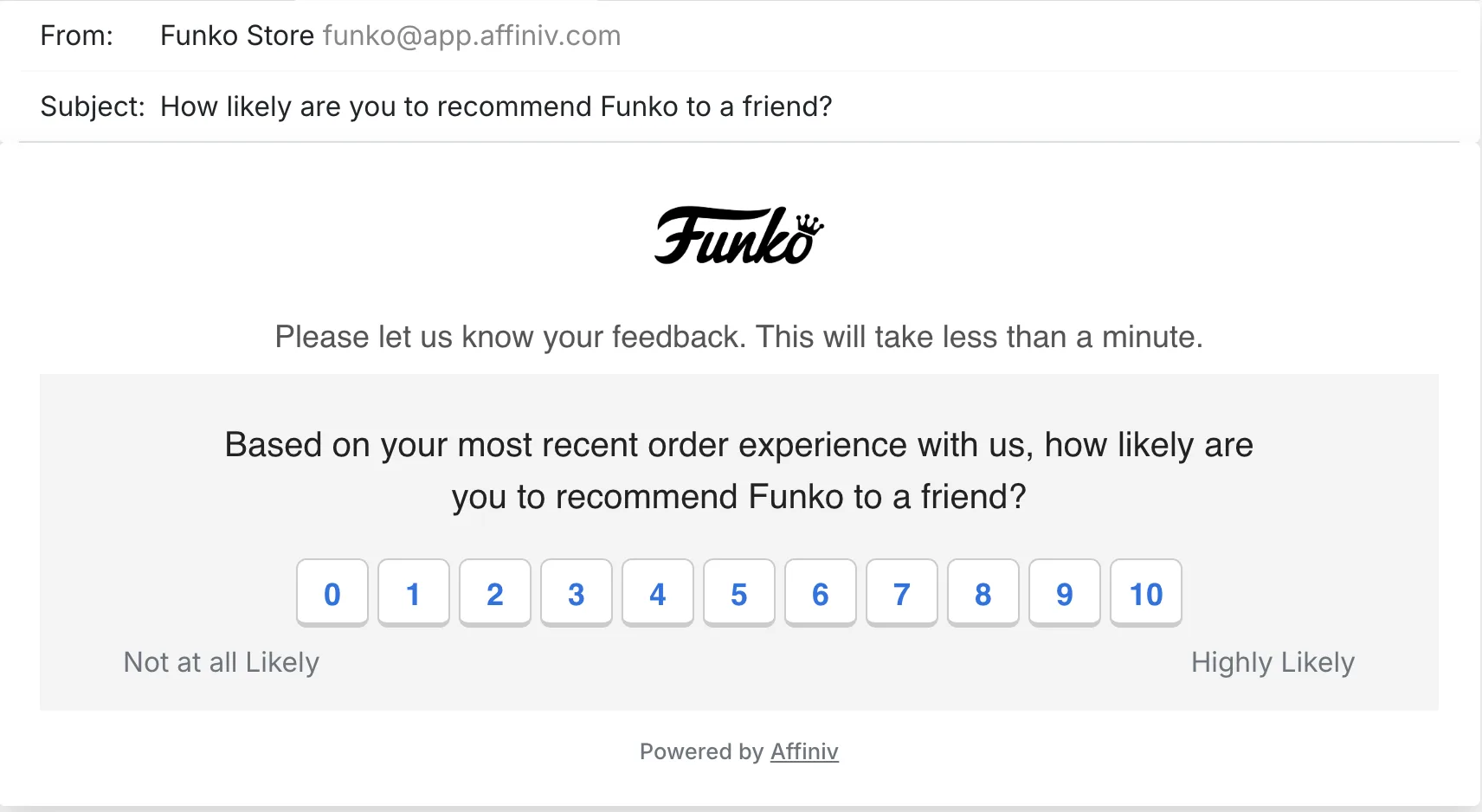
They use Affiniv to send a post-purchase NPS survey via email 15 days after the order. The survey includes custom follow-up questions based on customer responses.
Using Affiniv's Shopify app, the Customer Experience and Marketing teams at Funko get critical information for every survey response, including Customer ID, Order ID, SKU, City, Country, and more. This helps them segment responses and prioritize actions.
To close the loop, they use Affiniv's Zendesk integration to create an automated ticket for all detractors. This ensures the support team promptly contacts detractors and prevents churn.
Result: 9% increase in customer retention.
Monotype: SaaS User Effort Surveys
Monotype, the world's leading company in the typography and font technology industry, uses CES to gauge customer effort. They do it after several customer milestones, such as onboarding completion, the 10th font installed, and so on.
They have integrated these surveys as web popups in the user journey. The company uses survey throttles to avoid spamming users.
Based on users' feedback on difficulty in completing setup or other steps, Monotype identifies friction points in the user journey. The product and UX teams use these insights to simplify the steps and add guided tutorials.
Result: Higher activation rates and lower churn.
Chubbies Shorts: D2C Brand Helpdesk Survey
The customer experience team of Chubbies, a fast-growing brand that specializes in men's apparel designed for weekend comfort and leisure, uses CSAT after ticket resolution.
After every helpdesk interaction, Chubbies sends a survey to the customer via email and SMS. The survey starts by asking the customer to rate the interaction satisfaction on a 5-point scale and continues with follow-ups on the resolution provided, agent behavior, agent knowledge, wait time, and more.
Result: Better customer experience and an increase in repeat purchases.
Common Mistakes to Avoid in Feedback Loops
The hidden cost of a poorly designed feedback loop is very high. It isn't just ineffective; it is, in fact, detrimental to business growth. Avoid these common mistakes to ensure that your business genuinely benefits from a customer feedback loop.
- Collecting feedback without action: The most common mistake is collecting feedback but not acting on it. Nothing irritates a customer more than inaction from a business after the customer has taken the time to respond to a feedback request.
- Responding too late to customers: Another common mistake is responding too late. You have a short window to pacify a dissatisfied customer. A detractor who receives a response days or weeks later may already have decided not to engage with your business again. Assign clear ownership for follow-up and/or set up integration with your helpdesk to automate ticket creation for unhappy customers.
- Limiting feedback to the CX team: Customer experience and retention are outcomes of a multi-functional effort. Businesses that let CX teams run customer feedback loops in silos struggle to deliver a world-class experience. Make customer feedback accessible to stakeholders from all the relevant departments and ensure their representation while prioritizing actions.
- Not assigning ownership and timelines for actions: Teams struggle when ownership is unclear. If you identify a recurring issue in customer feedback, assign an owner to fix it. Avoid assigning ownership to multiple people. Also, to ensure prioritization, clearly align on a timeline and milestones, if needed.
- Deprioritizing CX reviews: Postponing or canceling CX reviews to manage other "burning" issues only creates more such issues in the future. Treat the CX review as the most important meeting that your company has. Use it to identify emerging patterns, get new insights, and review previous action items.
- Ignoring qualitative insights: Businesses that treat a healthy trend in NPS, CSAT, or CES scores as the sole indicator of customer satisfaction often fail to delight their customers. The insights needed to wow your customers are hidden in the open-ended responses. You may use AI features to get summaries and trends without going through each response, but ignoring qualitative feedback is a fatal mistake.
Measuring the Impact of Feedback Loops
Effective feedback loops lead to improvements in business KPIs. Scores alone are not enough — you must look at business performance to evaluate the effectiveness of your feedback loop.
Key metrics, besides the CX scores of NPS, CSAT, and CES, include customer retention rate, customer lifetime value, and revenue growth. The goal is not just to improve scores, but to drive better business outcomes.
For example, if your NPS improves but retention does not, you may need to investigate whether promoters are being activated properly or whether detractors are being recovered fast enough.
Tools for Managing Customer Feedback Loops
To efficiently set up and manage a customer feedback loop, you must use the right tool(s). The choice depends on the stage of your business, such as SMB or enterprise, and your use cases.
Traditional Survey-Only Tools
Tools like SurveyMonkey and Typeform are useful for collecting feedback. In the early stages of your business, you can also use free online form builders like Google Forms. However, these options lack workflow automation and real-time action capabilities, and they often do not complete the feedback loop on their own.
Enterprise Platforms
Platforms like Qualtrics and Medallia are pioneers of feedback loop management platforms. They offer advanced capabilities. But for small and medium-sized businesses, they can be complex, expensive, and resource-intensive.
Modern Customer Feedback Platforms
Modern platforms like Affiniv offer end-to-end solutions to automate the feedback loop. Affiniv is easy to use and affordable. It also has a Shopify App for D2C brands using Shopify storefront and/or Shopify POS. It integrates with your daily-use tools so you don't need multiple tools to run your customer feedback loop.
Visit this section to find detailed comparisons of the most famous customer feedback platforms and survey tools.
How Affiniv Helps You Build Feedback Loops
Affiniv is a modern customer feedback platform designed to help businesses collect feedback through multiple channels, get insights through AI-powered analytics, and take timely actions through integrations.
It is easy to set up and use. It enables teams to trigger surveys automatically, segment customers in real time, act on feedback instantly, and track performance continuously, all in an intuitive workflow. Instead of relying on disconnected tools or paying a hefty sum for complex enterprise-grade platforms, businesses can use Affiniv to easily build a unified feedback loop that scales with growth.
Want to See Affiniv in Action?
Book a no-obligation demo to see how you can build a customer feedback loop using Affiniv.
Conclusion
In a crowded market, businesses that actively engage with customers and adapt to their feedback stand out. This approach helps you retain existing customers and attract new ones who seek brands that listen and respond to their needs.
But collecting customer feedback alone doesn't lead to growth. Growth comes when you act on it in meaningful ways. Customer feedback loops are designed to do just that — they turn feedback into insights, insights into actions, actions into improvements, and improvements into growth.
Some key elements of a good feedback loop include a timely response to customers after feedback is received, analyzing qualitative responses to understand the context behind each rating, sharing insights across teams, and assigning clear ownership to act on the feedback.
Most importantly, using a modern platform to automate the customer feedback loop leads to an efficient, scalable system. The companies that succeed are not the ones who collect the most feedback — they are the ones who act on it the fastest and most effectively.
Feedback doesn't drive growth. Systems do.