
11 Most Effective Survey Question Types
Choosing the right survey question types helps you increase survey response rates, giving you accurate, actionable insights.
This article is your guide to the 11 most effective survey question types with real-world examples and tips, plus a quick table to help you choose the right one for your goals.
You'll also find best practices and how to ask the right type of questions using Affiniv's no-code platform.
Why Survey Question Types Matter
Want to draw impactful, actionable insights from your surveys? Well, then, make sure that the questions in your surveys are designed well.
Survey question types influence respondents' engagement levels and the insights they provide. Ask the wrong kind of questions, and even a thousand responses may not tell you what you need to know. They also determine how you collect feedback — whether it's numbers you can chart, or stories that explain why people feel a certain way.
The type of question can influence:
- How much effort does it take to answer
- How accurately respondents interpret it
- How useful will the data be afterward
Whether it's customer experience (CX), product research, or an employee feedback survey, using the right mix of question types makes the difference between guessing and knowing.
Let's dive into the 11 essential types of survey questions you can use to collect better insights.
Types of Survey Questions: The 11 Essentials
Different types of survey questions help you capture different elements of customer feedback — from emotional sentiment to measurable satisfaction. Choosing the right one can determine whether your survey yields insight or incomplete data.
Below are the 11 most effective question types used in modern surveys.
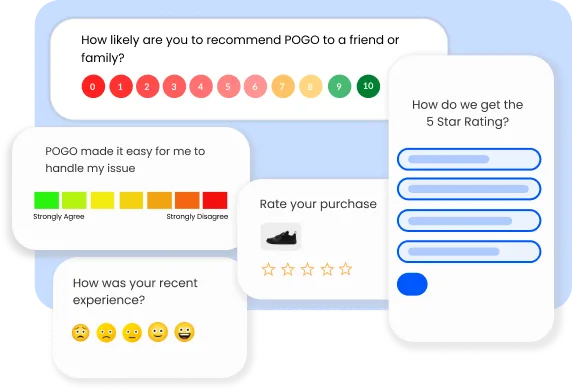
Let's learn the definitions, use cases, examples, and practical tips for each of them.
Multiple-Choice Questions
Multiple-choice questions are the most common survey question type. They allow respondents to choose one (single-answer) or more (multi-answer) options from a predefined list, helping you quantify opinions quickly and efficiently.
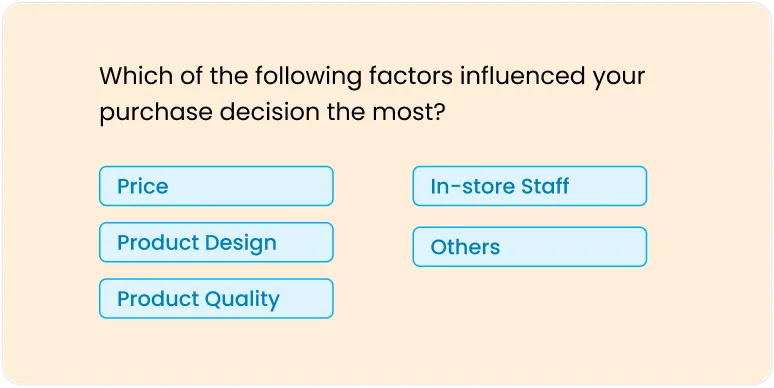
Example
Which of the following factors influenced your purchase decision the most?
Tips
- Keep options mutually exclusive and collectively exhaustive.
- Add an "Other (please specify)" option to capture missing perspectives.
Why it works: Multiple-choice questions are easy to answer and analyze, giving you clear, structured insights.
Rating Scale Questions
Rating scale questions ask respondents to rate a product, experience, or service on a defined scale. They can use different scales, such as numeric (e.g., 1-5), descriptive (e.g., "Poor to Excellent"), or visual (e.g., Stars/Smileys). They are best used when you need measurable satisfaction or performance data.
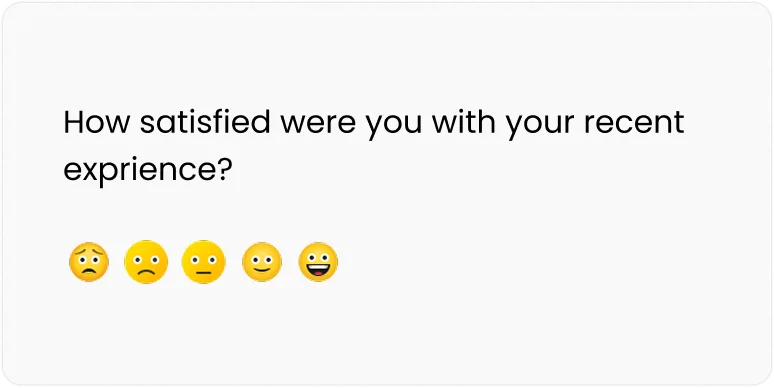
Example
How satisfied were you with your recent experience?
Tips
- Use consistent scale directions (low to high) throughout the survey.
- Use symbols that don't confuse the respondent. For a numeric scale, label both ends to define what the lowest and highest values represent.
Why it works: Rating scales quantify CX, making it easy to spot trends and track changes over time. Perfect for CSAT or NPS-type surveys.
Likert Scale Questions
The Likert scale helps measure attitudes or levels of agreement by asking respondents how strongly they agree or disagree with a statement.
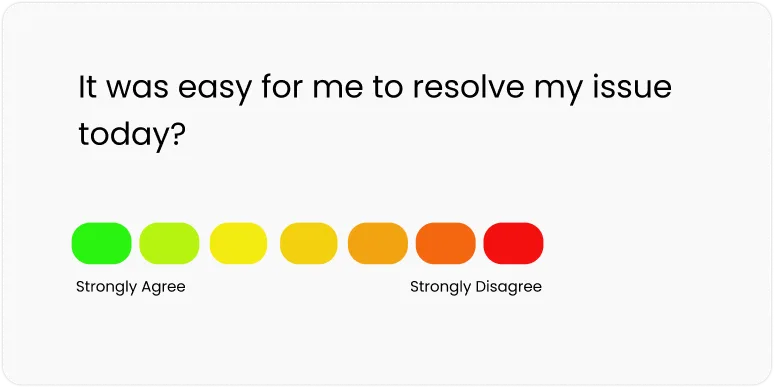
Example
It was easy for me to resolve my issue today.
Tips
- Use 5 or 7-point scales for better granularity.
- Mix positive and negative statements to avoid bias.
Why it works: Likert questions are ideal for CX research because they reveal "how" people feel, not just "what" they think. They're a goldmine for understanding sentiment.
Open-Ended Questions
Open-ended questions invite customers to express their thoughts in their own words, giving you rich qualitative insights that closed formats can't capture. They are perfect for collecting opinions, reasons, and stories that multiple-choice questions miss.
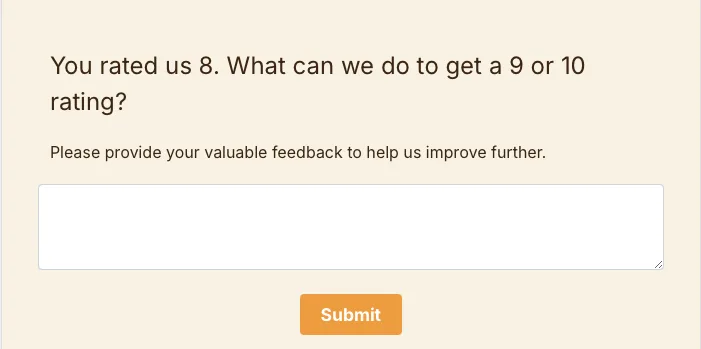
Example
You rated us 8. What can we do to get a 9 or 10 rating?
Tips
- Place them after quantitative questions for context-rich answers.
- Don't overuse them; 1–2 per survey is ideal.
Why it works: Open-ended questions help uncover the "why" behind quantitative scores. They're particularly useful in follow-up NPS, CSAT, or CES questions.
Close-Ended (Dichotomous) Questions
Close-ended or dichotomous questions offer only two possible responses - usually "Yes/No" or "True/False." They're simple and quick, ideal for binary decision points.
Example
Did our support team resolve your issue? (Yes / No)
Tips
- Use these early in the survey to segment respondents and design branching logic.
- Use follow-up logic (e.g., if "No", ask what went wrong).
- Don't use them to measure attitudes as they don't reflect the sentiments fully.
Why it works: Great for filtering and qualifying participants before deeper questions.
Ranking Questions
Ranking questions ask respondents to order a list of items based on preference or importance. This helps you understand priority rather than just selection. Some use cases include product feature prioritization and process gaps identification.
Example
Rank the following factors by importance when choosing a backpack: Utility, Design, Sturdiness, Storage Space
Tips
- Limit to 5–6 items to avoid fatigue.
- Randomize order to reduce bias.
- Offer drag-and-drop ranking for better UX.
Why it works: Ranking shows how respondents compare options. This is invaluable for prioritizing what to build, improve, or promote.
Matrix Questions
Matrix questions allow respondents to evaluate multiple items on the same scale, typically arranged in a table format. Use them to gather feedback across multiple attributes of a single product, service, or process at once.
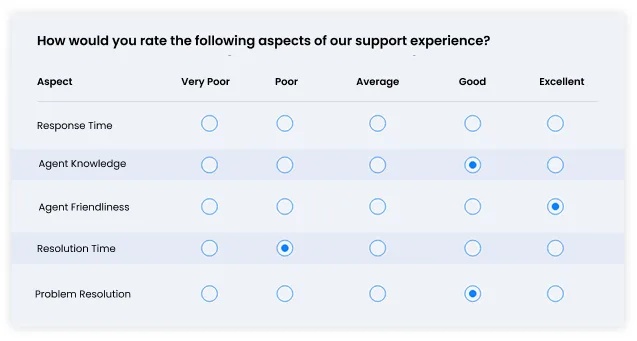
Example
Please rate the following aspects of our support experience:
Tips
- Limit to 5 rows and 4-5 columns to avoid cognitive load.
- Offer drag-and-drop ranking for better UX.
Why it works: Ranking shows how respondents compare options. This is invaluable for prioritizing what to build, improve, or promote.
Dropdown Questions
Dropdown questions display a scrollable list of options in a collapsible menu. They are essentially a kind of multiple-choice question. They're very helpful for long lists, making the list clean and compact.
Example
Which country do you live in? (Dropdown list of countries)
Tips
- Alphabetize lists for easier navigation, and use a neutral default like "– Choose one –".
- Avoid dropdowns for short answer sets (less than 4 options).
Why it works: Dropdowns enhance survey design and reduce clutter, particularly useful for mobile surveys with long lists.
Slider Questions
Slider questions let respondents choose a value by dragging a marker along a scale, offering a more interactive experience than numeric ratings. They are best for long scales, or measuring intensity or preference in a visual, engaging way.
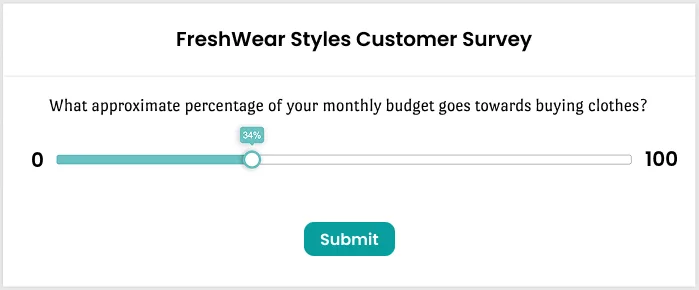
Example
Roughly, what percentage of your monthly budget goes towards buying clothes?
Tips
- Add labels at both ends to define the meaning of extremes.
- Keep the range intuitive (0–10, 1-100).
Why it works: Sliders improve engagement and are great for mobile devices. They give respondents a sense of control while providing granular data.
Image / Visual Choice Questions
These questions let respondents select images instead of text options. They tap into visual preference and emotional responses. They are highly used for creative testing, like product design, logo, or ad creatives.
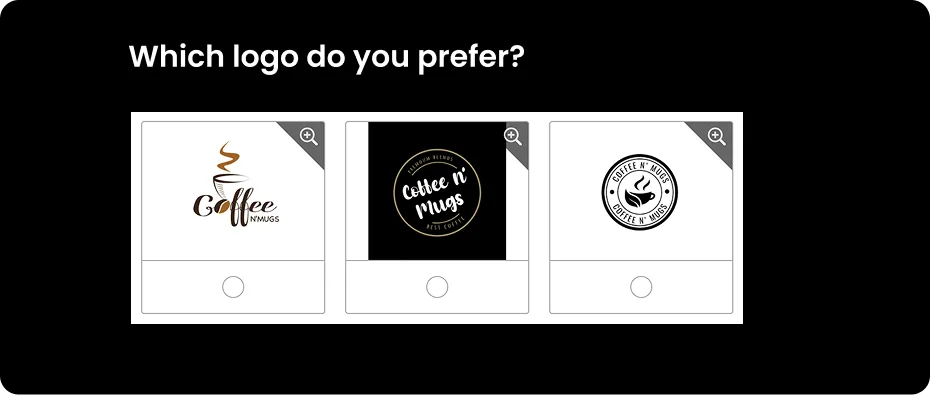
Example
Which logo do you prefer?
Tips
- Use high-quality, evenly sized visuals.
- Limit to 4–6 options to maintain clarity.
Why it works: Visuals help respondents engage faster and make intuitive choices. This is very useful for UI and product design testing.
Demographic Questions
The demographic questions collect background information like age, gender, income, or occupation. They're vital for segmenting and personalizing insights.
Example
Which of the following age groups best describes you? Under 18, 18–24, 25–34, 35–44, 45+
Tips
- Make demographic questions optional to respect privacy.
- Place them at the end of the survey, unless your questionnaire depends on them.
- For higher responses, remind respondents that their answers are confidential.
Why it works: They help you understand who your respondents are and whether certain groups feel differently. This enables deeper data segmentation inside your CX dashboard.
Build your surveys with Affiniv — free
All 11 question types are available. Create your first NPS or CSAT survey in under 10 minutes.
Start Free TrialHow to Choose the Right Question Type for Surveys
The right question type depends on five factors:
- Your goal — Measuring loyalty (NPS)? Satisfaction with an interaction (CSAT)? Qualitative insight (open-ended)?
- Your audience — B2B customers have more tolerance for longer surveys than B2C consumers.
- Sample size — Quantitative types (rating scale, multiple choice) need fewer responses to be statistically significant than open-ended.
- Survey channel — SMS surveys should be extremely short. Web popups can accommodate a matrix. Email can support 3–5 questions comfortably.
- Actionability — Can you act on the responses you'll get? If not, drop the question.
Not every survey question delivers the same kind of insight. The key to building an effective survey is knowing which type of question fits your goal — whether you want to measure satisfaction, understand emotion, or validate a product decision. Here's a goal-based guide to help you choose the right survey question type:
| Survey Goal | Recommended Question Type(s) | Example Question | Example Insight |
|---|---|---|---|
| Measure customer satisfaction or performance | Rating Scale, Likert Scale, Slider | "How satisfied are you with…?" | "75% of users are satisfied with..." |
| Understand reasons and customer sentiment | Open-Ended, Multiple-Choice | "What could we improve?" | "60% detractors want us to improve on..." |
| Identify preferences to prioritize features or improvements | Ranking, Matrix | "Rank these factors based on their importance while making a buying decision." | "Ease of use outranks pricing as a key buying decision." |
| Collect factual or eligibility data | Close-Ended (Dichotomous), Dropdown | "Were you happy with the resolution provided?" | "12% of customers were not happy with the resolution." |
| Test designs, or creatives | Image/Visual | "Which product appears to be more premium?" | "68% customers felt Option B was more premium." |
| Segment the audience for targeting | Demographic, Dropdown | "Which age group do you belong to?" | "35-44 age group reports highest satisfaction." |
Tip: No single type fits every goal. Most effective surveys blend 3–4 question types for a balanced mix of qualitative and quantitative data. Use Affiniv to create surveys with multiple question types seamlessly, apply branching logic, and visualize results instantly.
Best Practices for All Survey Question Types
No matter which survey question types you choose, the quality of your insights depends on how well those questions are designed and structured. Here are some dos and don'ts to ensure high response rates, with accurate feedback.
✅ Dos
- Have a clear goal
- Keep surveys short and focused
- Follow a logical flow
- Mix survey question types
- Use simple language
- Ask neutral and unbiased questions
- Make it visually smooth
❌ Don'ts
- Don’t skip "other" or "none" options
- Don’t collect unnecessary personal data
- Don’t ignore mobile experience
- Don’t launch without testing
- Don’t end abruptly
Affiniv's survey creator provides previews for both Desktop and Mobile. You can also track completion analytics — helping you refine question design, placement, and length for higher response quality.
Ask the Right Type of Survey Questions Using Affiniv
Designing smart surveys doesn't have to be complex. Affiniv's CX platform helps you build and distribute engaging surveys in minutes using no-code features.
Here's how Affiniv helps you ask the right questions:
- Multiple survey question types: Affiniv offers several question types (multiple-choice, Likert scale, numeric rating scale, visual rating scale, open-ended, etc.) with full customization.
- Combine questions: Design surveys with more than one type of question.
- Dynamic logic: Show or hide questions automatically based on previous answers.
- Templates: Start from standard CSAT, NPS, CES, and more survey templates, and ask follow-ups for deep dives.
- AI-powered CX dashboard: Visualize responses instantly to spot trends and gaps.
With Affiniv, you don't just collect answers — you uncover insights that drive action. For example:
- Q1 — Rating scale question (say, Post-Purchase NPS)
- Q2 — Multiple-choice question with different options for detractors, passives, and promoters
- Q3 — Open-ended question to gain deeper insights
- Q4 — Demographic question for segmentation
Survey Question FAQs
- For customer feedback surveys (NPS, CSAT, CES), 1–3 questions works best. Longer surveys see sharp drops in completion rate. For research surveys, 5–10 questions is reasonable — more than 15 typically hurts data quality.
- Rating scale questions (NPS, CSAT) and close-ended questions (Yes/No) have the highest completion rates because they require minimal effort. Open-ended questions should always be optional and placed last.
- Yes — but make it optional. Open-ended feedback is essential for understanding the "why" behind your scores. Making it mandatory kills completion rates.
- Use NPS to measure overall loyalty and advocacy potential (quarterly or after major milestones). Use CSAT to measure satisfaction with a specific interaction (post-support, post-purchase, post-delivery).
How many questions should a survey have?
Which question type gets the highest response rates?
Should I always include an open-ended question?
How do I choose between NPS and CSAT?
Build surveys that drive real insights
Affiniv supports all major question types with logic jumps, AI analytics, and multi-channel distribution. Free up to 25 responses.